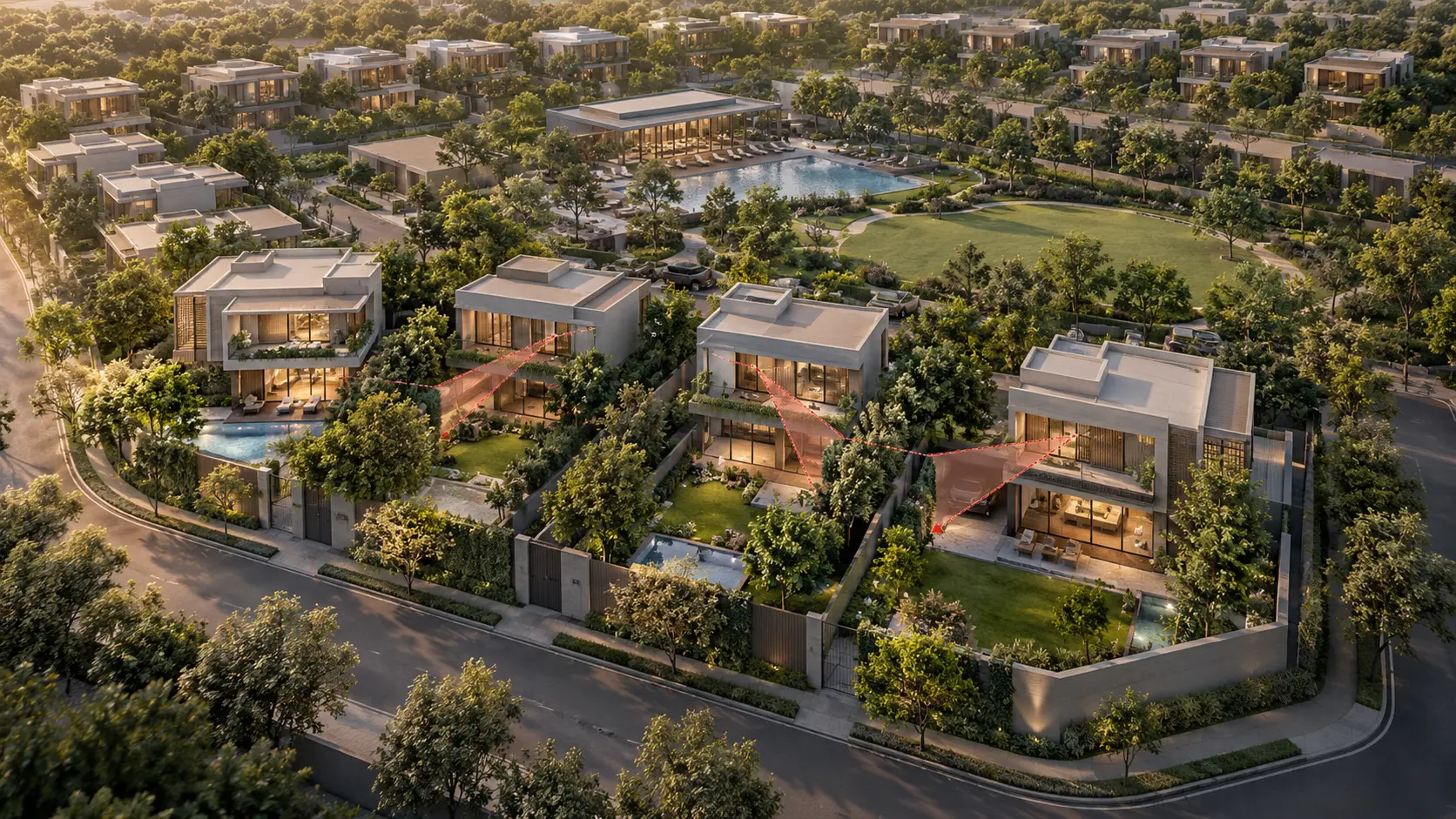
A villa layout gets checked for privacy exactly once, in the render. The corner plots — the ones that end up on the brochure cover — get looked at from three angles until no window lines up with a neighbour's terrace. The other hundred-odd plots in the same scheme inherit the same setback and orientation as whatever plot was drawn next to them, because nobody has time to check every pairing by eye.
That gap doesn't show up in a walkthrough of the model. It shows up months later, when a resident on a plot nobody rendered asks for a boundary wall raised, or a buyer late in the phasing notices their garden faces straight into a neighbour's living room and wants a price adjustment before signing.
The corner plot gets checked. The rest of the layout inherits its neighbour's orientation
A large villa scheme — plotted in rings around a shared amenity, a few hundred units deep — is usually laid out by eye, plot by plot, from whichever edge the planner started on. Each new block copies the orientation of the one before it, because that's the fastest way to keep a layout looking consistent. The result is long runs of villas facing the same direction down a row.
That's efficient to draw and invisible to catch. A hero render shows four or five villas around the clubhouse, checked carefully, oriented so nothing overlooks anything. It says nothing about the plot three rings back that inherited its orientation from the one before it without anyone re-checking whether the two gardens now face each other across a shared long wall.
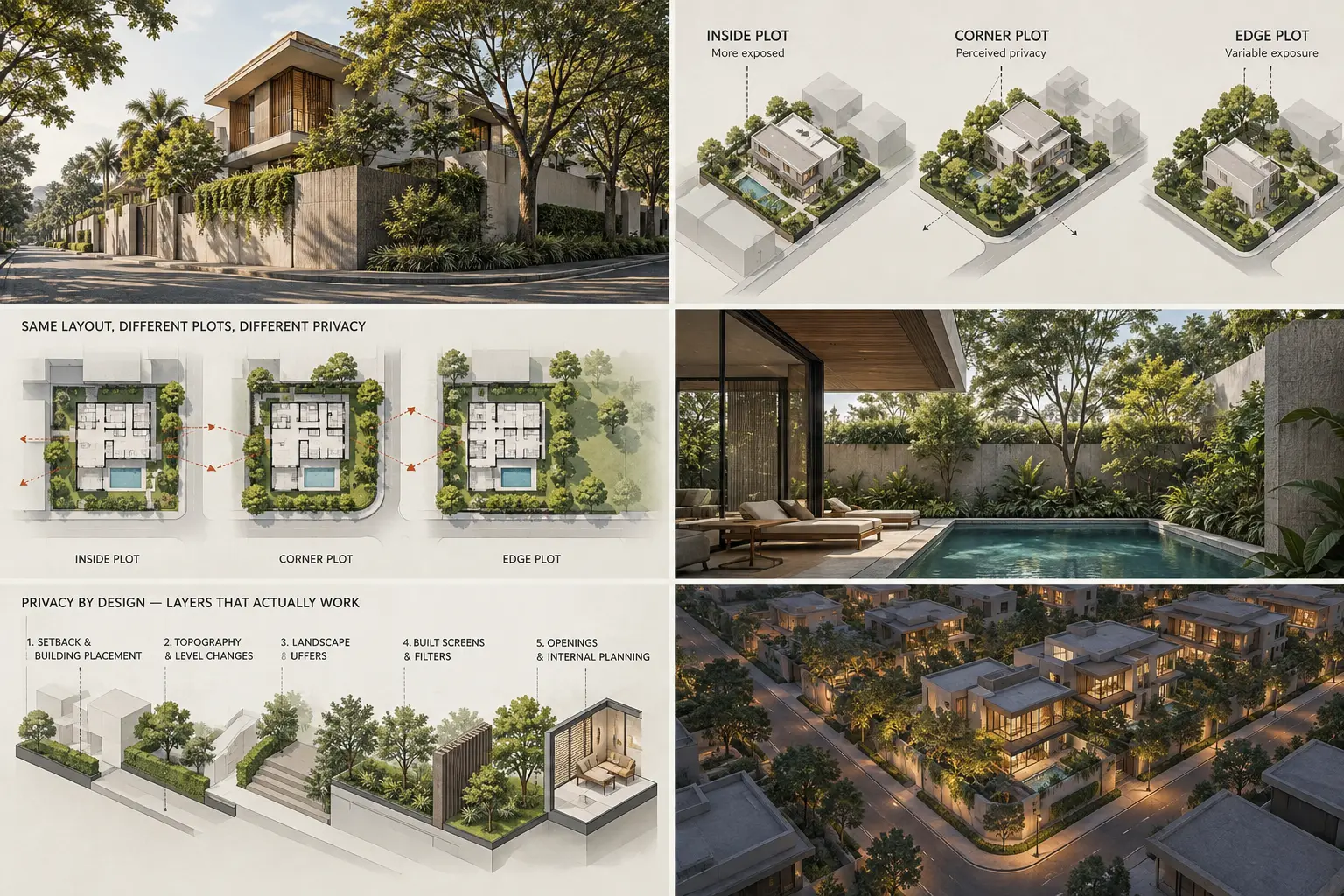
Privacy is a relationship between two plots, not a property of one
The fix isn't a better render. It's treating privacy as a rule applied to every plot boundary in the scheme, the same way a setback or an FSI limit is applied — not as a design choice made once and copied forward.
The rule is simple to state and easy to check mechanically: no two villas face each other across a long wall, short-wall facing is acceptable, and no unbroken run of identically-oriented plots is allowed to repeat down a row — orientation has to flip often enough that the layout doesn't read as a corridor. Applied plot by plot across a few hundred units, that turns privacy from a judgment call made on the plots someone happened to look at into a property that can be verified on all of them, including the ones that never make it into a render.
What a rule catches that a walkthrough doesn't
The failure mode a manual layout misses isn't any single pair of villas — it's the run. A row facing the same way for eight or ten plots in sequence doesn't look wrong from a hero angle showing three of them. It looks wrong from the ground, to the resident in the middle of that row, looking straight across a shared wall into a neighbour's garden that was never meant to be visible from there.
That's also where the commercial cost sits. A developer selling "no direct overlook" as part of a premium — on corner plots, edge plots, whichever units carry the higher rate — is making a claim that only holds if it's true for every plot carrying that premium, not just the ones in the sales deck. A single re-negotiated boundary wall or price adjustment after possession costs more than the hour it would have taken to check the rule against the full plot count before launch.
Where the judgment stays
The rule decides adjacency and orientation. It doesn't decide where the clubhouse sits, how the golf routing should feel, or which plots deserve the premium in the first place — those are calls a person makes, walking the site, weighing views and approach roads against the numbers. What the rule does is make sure that whatever privacy standard gets promised on the plots someone checked also holds on the plots nobody did.
Every villa layout carries a privacy claim somewhere in its sales narrative. If you want that claim checked against the whole plot count before it goes into a brochure, that's exactly what the 7-day review is for. Start a review.